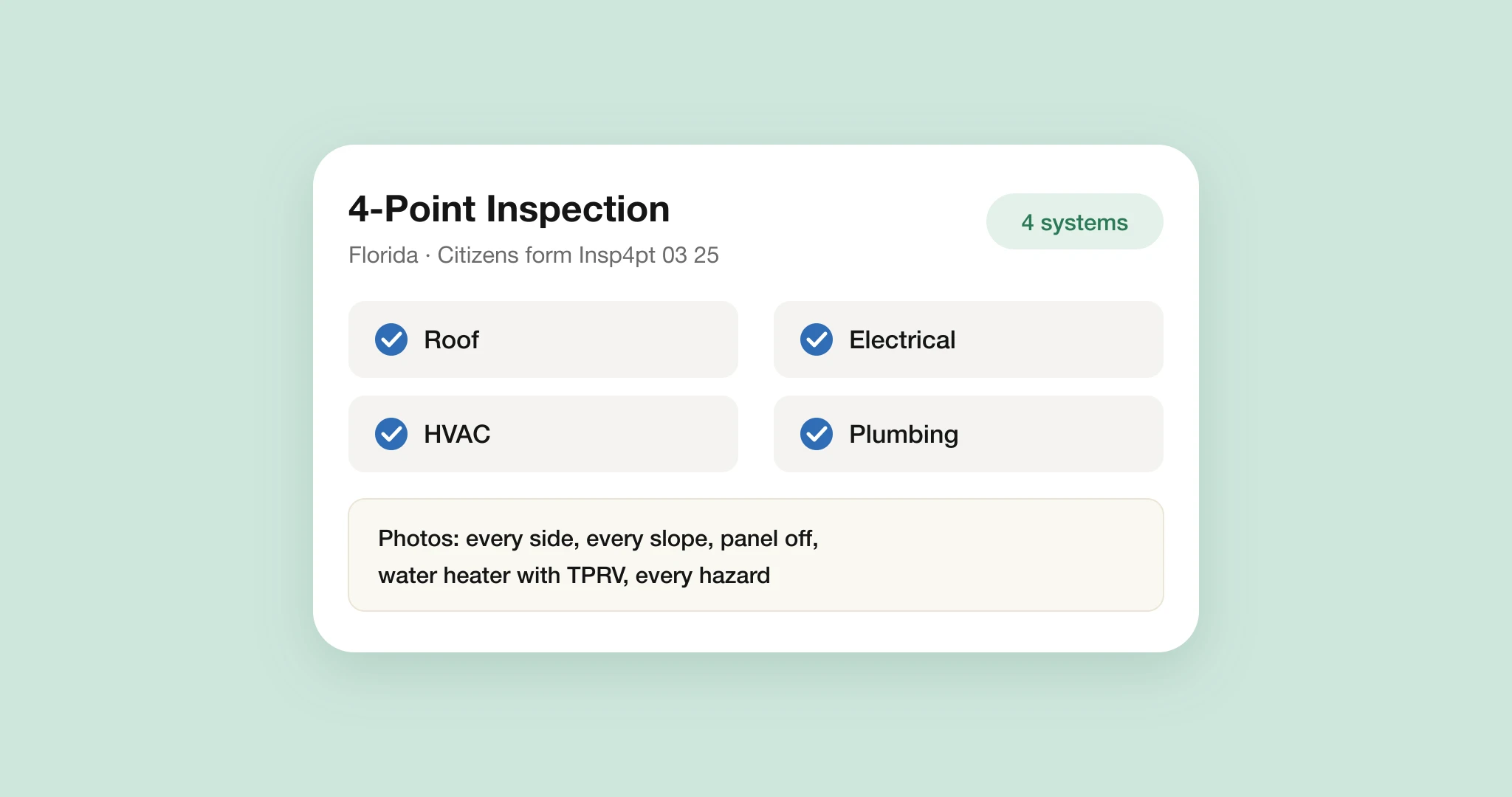
A 4-point inspection is short: four systems on four pages. It’s also easy to get sent back. An underwriter reads every box, and one missing photo or an “unknown” with no explanation sends the form back to the agent, and then to you.
This is the checklist we wish every new Florida inspector had on day one. It follows the Citizens sample form, Insp4pt 03 25, section by section. Citizens says that exact form isn’t required, but any other report has to include “at least this level of detail”, so it’s a good baseline whichever carrier you’re writing for.
Who asks for one, and who can sign it
The 4-point isn’t a state law. It’s an underwriting rule. Insurers want it before they write or renew a policy on an older home. Citizens asks for one on homes more than 20 years old (it was 30 until 2022). Other carriers set their own age, so the agent is the one to ask.
The form has to be completed, signed and dated by a verifiable Florida-licensed professional. Citizens names a general, residential or building contractor, a building code inspector, and a home inspector. A licensed tradesperson can sign only their own section, so an electrician can sign the electrical part and nothing else.
Before you go
Most of the blanks that come back empty are things you can’t see on site. Ask for them when you book:
- The application or policy number. The homeowner or their agent has it.
- The actual year built. Check the county property record, not the listing.
- Update years. When was the roof replaced, the panel changed, the house re-piped? Permits are best. The homeowner’s memory is second.
- Aluminum wiring paperwork. If the house has single-strand aluminum branch wiring, the form needs separate documentation of all remediation, certified by a licensed electrician. You can’t produce that on site, so ask for it up front.
The photos
The minimum photo list is short, and underwriters check it:
- Each side of the dwelling
- Each slope of the roof
- The water heater, including the temperature and pressure relief valve (TPRV)
- Under-cabinet plumbing and drains
- Exposed valves
- The main electrical panel, open, with the interior door label
- The electrical box with the panel (dead front) off
- Every hazard or deficiency you note anywhere on the form
Two are easy to miss. One is the TPRV, which hides on the side of a water heater in a dark closet. The other is the panel-off shot, because it’s the one that takes a screwdriver. If you mark a hazard, it needs its own photo too. A box ticked “scorching” with no picture of the scorching is asking to come back.
Electrical
For the main panel, and a second panel if there is one:
- Breakers or fuses
- Total amps, and whether that’s enough for how the house is used now. A “no” needs an explanation.
- Panel age, year last updated, and brand and model. Get the label in the photo. Some brands make underwriters look twice, and they’ll want to see it for themselves.
For the system as a whole:
- Wiring type: copper, NM, BX or conduit, multistrand or single-strand aluminum, copper-clad aluminum, cloth or rubber insulated, and so on. The panel-off photo is where you prove it.
- Cloth wiring, active knob and tube, or branch circuit aluminum. For aluminum, describe how it’s used and whether the connections were repaired with COPALUM crimps or AlumiConn connectors.
- Hazards: blowing fuses, tripping breakers, empty sockets, loose wiring, improper grounding, corrosion, over-fusing, double taps, exposed or unsafe wiring, improper breaker size, scorching.
- General condition: satisfactory or unsatisfactory. Unsatisfactory needs an explanation.
HVAC
- Central air, central heat, and if there’s no central heat, the primary heat source and its fuel
- Whether the system is in good working order, and when it was last serviced. A service sticker on the air handler often answers the second question.
- Any wood-burning stove or central gas fireplace, and whether it was professionally installed
- Any space heater used as the primary heat source, and whether it’s portable
- Any sign of blockage or leakage at the air handler, condensate line or drain pan, including water damage around it. In Florida, look at the pan every time.
- Age of the system and year last updated. The form asks for photos of the equipment “including dated manufacturer’s plate”, so photograph the data plate where the date can actually be read, not just the unit.
Plumbing
- Is there a TPR valve on the water heater?
- Any sign of an active leak? Of a prior leak?
- Where the water heater is, and how old it is
- The condition of ten fixtures and connections, each satisfactory, unsatisfactory or N/A: dishwasher, refrigerator, washing machine, water heater, showers and tubs, toilets, sinks, sump pump, main shutoff valve, and all other visible. Anything unsatisfactory needs details: leaks, wet or soft spots, mold, corrosion, grout or caulk.
- The supply and drain piping, each original, completely re-piped or partially re-piped, with the year and extent of the work
- Every pipe type present: copper, PEX, PVC/CPVC, galvanized, cast iron, polybutylene, ABS. Check all that apply. Galvanized, cast iron and polybutylene are the ones underwriters tend to read closely, so look under the sinks and at the water heater before you tick only “PEX”.
Roof
For the predominant roof, and a secondary roof if there is one:
- Covering material
- Roof age and remaining useful life, in years
- Date of the last roofing permit and the last update, and whether that was a full or partial replacement (with the percentage)
- Overall condition. Unsatisfactory needs an explanation.
- Visible damage or deterioration: cracking, cupping or curling, excessive granule loss, exposed asphalt, exposed felt, missing, loose or cracked tabs or tiles, soft spots in the decking, hail damage
- Visible signs of leaks, both in the attic or on the underside of the decking and on interior ceilings
One detail worth knowing: with a photo of each roof slope, this section can take the place of a separate Roof Inspection Form. That’s one more reason not to skip a slope.
Underwriters don’t read the 4-point like a client reads a report. They read it like a checklist, and every empty box is a question.
The comments box isn’t optional
The last section, Additional Comments/Observations, has to be filled in with full details whenever any of these is true:
- Updates. What was updated, when, and by whom.
- Any visible hazard or deficiency.
- Any system not in good working order.
So on most older houses, it’s required. Write it the way you’d explain it to the agent on the phone: what you saw, where, and what it means for the system. “Panel replaced 2019 per permit, 200 A, no hazards observed” saves a callback.
Then sign it with your title, license number and license type, and your company name and work phone. Remember what you’re certifying. The form defines acceptable condition as each system “working as intended” with “no visible hazards or deficiencies”.
Doing it alongside a home inspection
A lot of 4-points ride along with a buyer’s home inspection, and most of the evidence overlaps. You’re already photographing the panel, the water heater and the roof. The trick is to take the 4-point versions of those photos on the same pass (panel off, TPRV in frame, data plate readable, every slope) so you don’t have to walk back for them.